
Not Worth It Anymore. Nationalism on the Agenda
Why the belief in nationalist, ethnic, and other harmful mythologies is not just a reconstruction and a historical atavism, but primarily a serious obstacle to the salvation of Life on planet Earth.
A hideous time of day to you!
And let us begin, perhaps, with the formulation of the problems. There are three main ones, from which most of the others largely derive. Here, I must admit, I didn’t overcomplicate things and turned to the well-known philosopher and historian Yuval Noah Harari. In recent years, his works have achieved bestseller status, although their main merit, in my humble opinion, lies in the simplicity of exposition and the most banal systematization of various branches of human knowledge about itself and the surrounding reality. In other words — a kind of unpretentious pop-sci about our past, present, and future as a species.
Closer to the point!
Yuval and I have reached a consensus on the matter, which boils down to the following:
Modern humanity faces 3 fundamental questions1, the resolution of which determines not only the fate of our species but also the fate of all living organisms on planet Earth. At the very least. I’d like to begin with the question I’ve been working on for a long time — and on which I’ve already worn down more than one set of teeth:
1. Ecological crisis
Here, by the way, Harari disappointed me in his latest book “21 Lessons for the 21st Century”, as when discussing climate change and its consequences for ecosystems and biocenoses, he mostly resorted to liberal clichés and narratives, talking about the overexploitation of fossil fuels and so on. He only briefly — or almost not at all — touched upon the main cause: animal husbandry (and agriculture2 in general).
But how is this connected to nationalism, as mentioned in the title?
Very simply — the modern world is global. You may like it or not, some might even be thrilled at how fast we can travel or communicate across vast distances.
But the problems brought by our high-tech civilization affect everyone, almost regardless of where they live.
To dispel any doubts right away, let me give just a couple of examples:
First of all, climate change itself is the result of human activity. If you disagree, congratulations — you’re a dark-ages reactionary3. The scientific community has an absolute consensus on this matter.
Our very civilization owes its existence to logistic chains4, which allow energy and goods to be transported literally to the other side of the planet. This makes all countries interdependent in every possible way: economically, energetically, and politically. And most importantly — ecologically. Because an accident at some factory leads to poisoning of hundreds or thousands of kilometers of rivers and lakes. A plastic bottle you throw into the stream near your house5 might, in a few months or a year, end up in the stomach of a whale in the Pacific Ocean. A nuclear power plant disaster can render an entire continent uninhabitable6. And there are endless examples like this.
The conclusion is this — we are in deep trouble. Right now, the fate of the vast majority of living organisms on our planet is being decided. Who will save us?
Stable, independent nation-states, capable of taking care of themselves and building good-neighborly relations with other political entities?
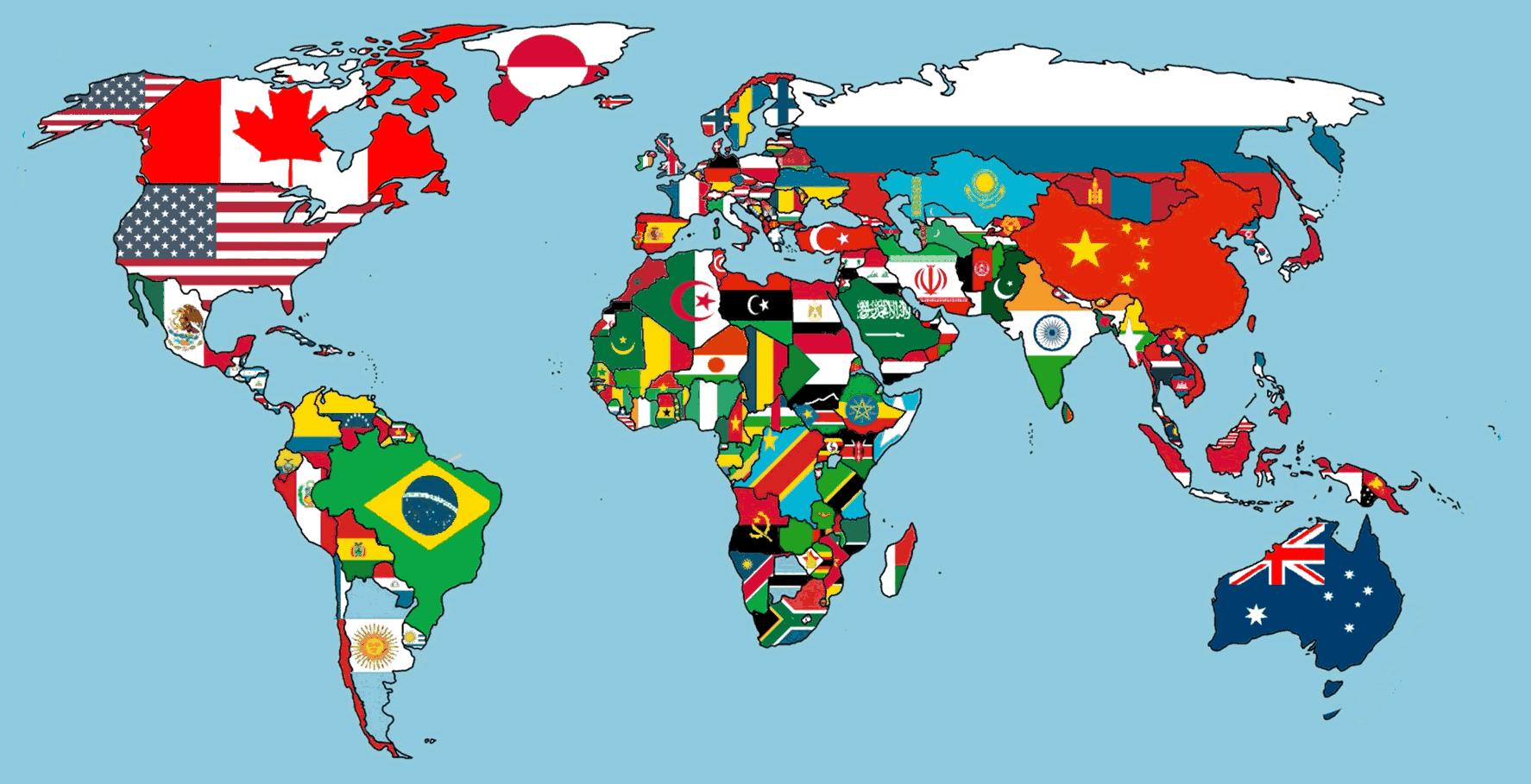
What utter nonsense! Yet, we hear it often, especially now, when colorful rags and national slogans are replacing the brains of even those who previously showed some signs of mental activity.
By analyzing the political programs of nationalist (and the vast majority of) politicians and parties, you'll see that they are trying to ignore this issue.
NATIONALISM HAS NOTHING TO OFFER IN SOLVING THE ECOLOGICAL CRISIS
Which is natural and not surprising, as the prerogative of national leaders will always be things like the economic well-being of the country's citizens, independence in making political decisions, the enrichment of elites (if we’re being fair), and the preservation (or expansion) of borders.
In fact, this is a prioritization of local, small-scale interests over global ones, which, for a small national leader or even a representative of a multi-million population, are something distant and unresolved.
And that’s how it is! How, tell me, can Biden influence Chinese factories or manufacturing enterprises, the harm of which is quite palpable even thousands of kilometers away? If he could, would he? After all, the economic agreements that benefit the nation depend on the well-being of voters, and therefore on the position of the government.
Would a political leader risk the stability and development of their own country for the sake of the population of disappearing tigers or fish? The answer is obvious.
I’m sure that most sharp-witted and perceptive readers will themselves come up with a dozen examples where the interests of the Nation became a heavy boot on the throat of Nature.
2. Rapidly Developing Technologies
Yes, this is another important point where Yuval and I are 100% in agreement.
"But what’s the issue here?" — you might ask, "Can’t neighboring independent states develop harmoniously for the benefit of collective progress?"
Oh, oh, oh…
No, they cannot.
The main aspect of such development is precisely the opposition and competition of the marketplace, which, as you can see, has already done its work.
Anticipating your confusion about the question, “What’s so bad about technological progress and why is it as global a problem as the ecological crisis?” I’ll immediately share the favorite fable of most anthropologists and biologists (with an important meaning):
Imagine a baboon who sees a palm tree with bananas in the middle of the savannah7.
Everything would be fine, except there’s a lion prowling near the palm tree.
Now the baboon faces a series of extremely important questions: - How hungry is he? - How many bananas are on the tree? - How far is the palm tree? - How far is the lion from the tree? - Can the baboon wait for the lion to leave, or will he collapse from hunger? - Does the lion look full or hungry and aggressive?
And a number of others. The trouble is that the baboon has no calculator or observational tools. Or does he?
Scientists agree that he does. These are the baboon’s senses: smell, sight, hearing, and his ability to make a complete picture of the world.
All of this was given to the baboon by millions of years of evolution in his ancestors.
In fact, the entire baboon is a biological algorithm with its own computational power.
And now, watch closely, here comes the trick:
To date, the scientific community has no other answer for you except that each of us is exactly the same biological algorithm, with more complex computational operations.
The baboon is trying to deceive the lion and eat the banana? Well, we choose a political leader, plan a family budget for several years, maybe buy a car, or build a relationship with a partner.
Sadly, the soul, the deep self, or the divine spark has yet to be found in the bald monkey…
Then, an even more fascinating magic unfolds, stay with me!
So, let's assume we are a biological algorithm. But we don’t know ourselves very well, and often due to hunger, stress, or hormonal disruptions, we tend to make decisions that are absolutely harmful to ourselves and others.
For example, research shows that judges (in countries with more or less independent judicial systems) tend to give harsher, freedom-depriving decisions if... they are hungry8... How simple, right? It’s hunger that causes an increase in glucocorticoids in the body, and as a result, increases stress and aggression, calling on the amygdala. But let’s not get sidetracked.
To the technology!
You are scrolling through Instagram. Your pupils dilate at the sight of pastries. A dopamine (satisfaction hormone) response from your body. Your gaze does not focus on the dough, but mainly inspects the fruits adorning the pastry on top. All this is captured by the camera, which is in every device just above the screen. Which fruits do you like the most, which shaped pastries do you look at longer, and which ones do you scroll past, the red, white, or brown color—what do you prefer?
ARTIFICIAL INTELLIGENCE will snap those little quirks of yours in no time.
And suddenly, you won’t even realize how your devices have flooded with pictures and videos of those beautiful pastries, a dozen of which you’ve already eaten in the last couple of days.
It’s great if the capitalists limit themselves to just manipulating your sweet tooth attachment (which is also deadly – more people die from diabetes than from wars). Someone will inevitably want to shape your political preferences, cultural and value narratives.
You don’t need to be much better than you – just know you a little bit better than you know yourself.
End of story, the biological algorithm “human” has been hacked9!
And this is just one of the problems of the modern age, which is already completely destroying the concept of free will.
Back to our sheep? Will nation-states help with this?
Or will they be ready to pay any amount of money to gain even a fraction of such control over the internal market of voters and consumers?
What about other countries? If they use this against us?! How terrifying! We urgently need to direct all resources toward developing the latest software and the most advanced AI10!
Because if one country decides to give its people a choice, to slightly slow down Big Data and Machine Learning technologies, putting ideals of freedom and individual independence above superiority over neighbors – it risks the fact that within a couple of months, neighboring states, who haven’t shown such awareness, will hack all the banking and military systems of the good guys.
Will anyone pause in such a situation?
3. Nuclear weapons. Our favorite echo of the 20th century
As we can observe lately, the risk of global nuclear war is closer than ever in history. Meanwhile, the concept of weapons of mass destruction, just like high technologies combined with AI, serve the most aggressive and horrifying goals of national or multinational state formations.
Since humanity reached a certain level of technological development, where a small group of people has the ability to erase cities and countries from the face of the Earth11, isolationism in individual countries is pure madness.
Who can know what kind of madness tomorrow’s dictator or leader of nations will dig up from the vaults of history to justify the need to bring a neighboring country or small nation to consensus or democracy?
The whole nuclear weapons situation is like a game of poker in a closed room, where all the players have their guns pointed at each other, and all of them have a terrible hand.
And we’re waiting for the shot, being in the same room, unarmed, fully aware of the complete lack of our own subjectivity.
What can nationalism and independence help us with here?
What conclusion can we draw from all this writing?
Things are unbelievably bad. Worse than ever, because never before in history have we had the forces capable of wiping out all evolution on our beautiful planet.
And there’s no reason to believe that anyone is really trying to fix it.
All these screams, soaked in the democratic free world, Russian ideals, or the collective good of cyberpunk under the heavens (and many others smaller) - resemble the howl of a dying beast devouring itself with no chance of stopping.
Every state’s multicolored rag must be spat upon and rejected, along with all its centuries-old sanctity and history, every idea that limits the global perspective must be trampled and cast into darkness.
We have almost no time left…
-
Yuval Noah Harari, "21 Lessons for the 21st Century". Sindbad, Moscow, 2022. ↩
-
John Zerzan, "Future Primitive", a collection of essays and articles. ↩
-
Meta-analysis of 88,125 peer-reviewed scientific works published between 2012-2020, Cornell University. ↩
-
Derrick Jensen, "Endgame". ↩
-
Scientific study published in PLOS One journal on December 2, 2020. A GPS tracker in a bottle thrown into a river showed a path of 1,767 miles (2,844 km). ↩
-
Georgy Lepin and Ivan Smolyar, "Nuclear Energy – the 'Peaceful' Killer". ↩
-
Robert Sapolsky, "Behave: The Biology of Humans at Our Best and Worst". Alpina Non-fiction, Moscow, 2021. ↩
-
Robert Sapolsky, "Behave: The Biology of Humans at Our Best and Worst". Alpina Non-fiction, Moscow, 2021. ↩
-
Yuval Noah Harari, "21 Lessons for the 21st Century". Sindbad, Moscow, 2022. ↩
-
"The Social Dilemma", a documentary by Netflix, 2020. ↩
-
Theodore John Kaczynski, "Industrial Society and Its Future". ↩